Centralizing Brand Guidelines as a Readable Context Layer Across Your Entire Agent Fleet
One shared brand source keeps every agent on voice and on-brand.
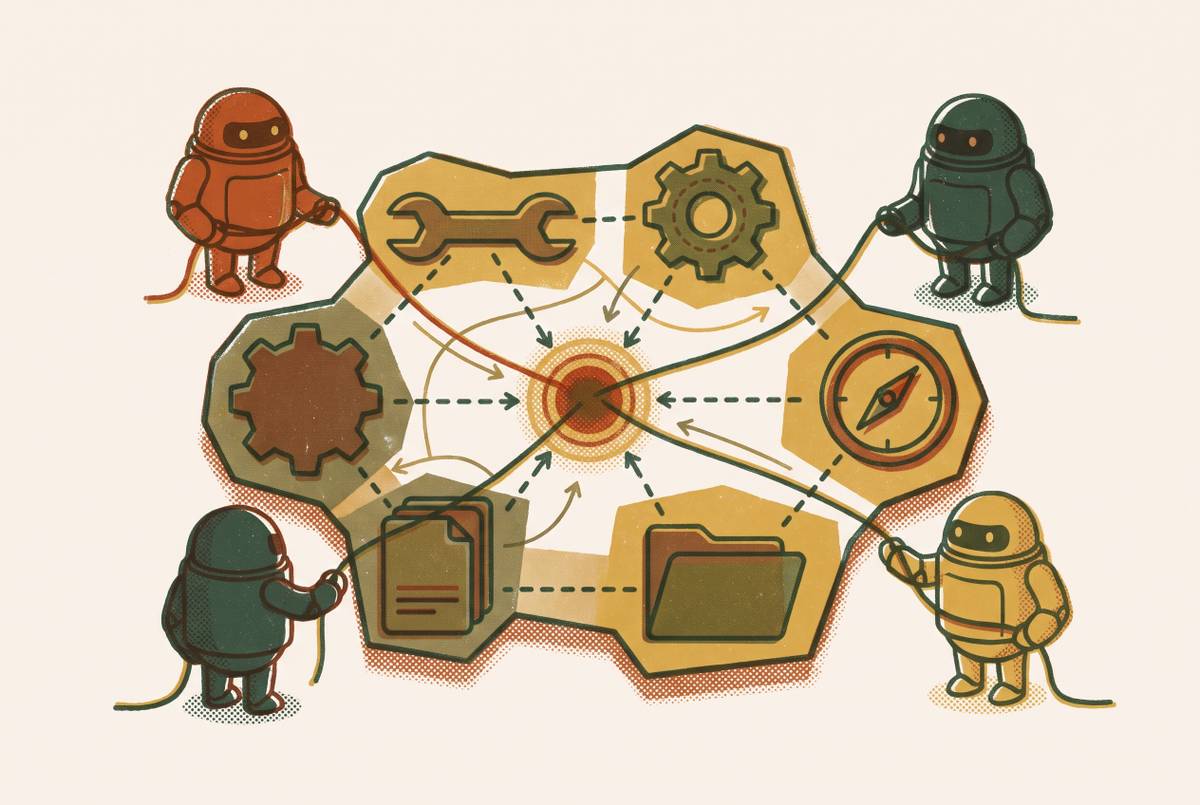
The brand layer for agents is a centralized, machine-readable source of voice rules, approved examples, and design values that every agent uses. Keeping a fleet on-brand requires that shared source, a live delivery connection, and review against the same rules. This is an infrastructure problem because individually correct outputs can still produce a collectively incoherent brand.
Why agent fleets develop brand drift even when every individual agent performs correctly
A copy agent writes clearly, a design agent chooses a legible color, and each output passes its local checks. Yet the resulting campaign does not feel like one brand. Each agent has optimized its assigned task using an isolated interpretation of the guidelines. Nothing enforces coherence between those interpretations.
That failure is agentic brand drift, and conventional performance measures can miss it. Task metrics may improve while the work as a whole slowly loses what makes the brand stand out. Unlike a human employee publishing an obviously off-brand asset, this process has no clear triggering event. There may be no individual mistake to flag. The unit of failure is the pattern of outputs.
Safety checklists and AI policy documents govern behavior and risk, but they do not establish whether a fleet preserves brand meaning. Approval workflows also assume that human reviewers can catch departures before publication, while fleet-scale production can outpace their capacity. A team can follow its AI governance framework correctly and still lack the infrastructure needed to keep its agents’ work coherent.
Why pasting brand guidelines into prompts cannot fix a fleet-scale coordination problem
Prompt-level brand instructions are copies. When a brand changes its typeface, revises its tone, or retires a color, distributed snippets have no mechanism for adopting the change together. Different agents and team members continue working from different snapshots. A new session introduces another opportunity for fragmentation because sessions are stateless by default and require the correct context to be supplied again.
A PDF or shared Google Doc may contain the right rules without presenting them in a form agents can reliably query. The document stays outside the agent’s context until someone puts its contents there. Even then, the agent cannot establish that the supplied copy is current merely because it appears authoritative.
Across a campaign, this fragmentation becomes style creep. People use different prompts, and assets slowly drift apart in tone and appearance even though each still looks like it could fit. More detailed prompts do not keep different versions of brand instructions in step. In software configuration, a single versioned config store takes the place of emailed files because separate copies cannot reliably keep a changing system in step.
What a machine-readable brand context layer actually contains
A usable context layer decomposes brand identity into three structured components, namely a voice profile, a body of annotated work, and design tokens. The voice profile sets out tone, vocabulary, sentence structure, and choices to avoid in clear rules that agents can query. It replaces broad descriptions with usable constraints. The annotated body of work then shows how those constraints operate in approved examples, with notes explaining what makes each example fit the brand.
Design tokens provide exact, reusable visual and structural values, including color codes, type scales, and spacing. These values remove ambiguity from choices that should be consistent. Tokens alone, however, do not explain composition. A separate short document must set out image-to-text ratios, signature devices, and layouts the brand never uses, because an agent can use the right palette and still get the overall feel wrong.
Open specifications show convergence around this structured approach. brand.md is an openly licensed specification for expressing brand identity in a structured Markdown file at an AI project’s root. Google Labs released DESIGN.md through its Stitch AI design tool as an open-source draft specification that pairs YAML design tokens with text explaining why the values exist. Both make brand knowledge directly readable by AI tools. On its own, neither file format has the delivery and governance needed to keep that knowledge up to date across the fleet.
How can multiple AI agents access the same live brand guidelines through MCP?
Model Context Protocol gives agents a standard interface to connect to external tools, databases, and APIs. It works like USB-C for AI connections, giving them a common interface in place of separate ways to connect. Anthropic released the first specification in November 2024, and the standard is now under the Linux Foundation’s Agentic AI Foundation. For brand governance, the important change is architectural. Teams connect agents to one source.
An MCP brand server exposes that source through resources, tools, and prompts. Resources provide read-only material such as the voice profile, design tokens, logo usage rules, and approved imagery. Tools support live requests for the current primary typeface or an approved campaign palette, as well as checks on whether a hex value is on-brand. Prompts provide reusable brand voice templates that agents invoke for each task. The three primitives give the same source several task-appropriate forms.
Instead of relying on agents to encounter and interpret indexed material, the brand controls what connected agents can read and how they interact with it. A source update becomes available through the shared connection without manual redistribution. It establishes an authoritative reference that generation and review can both use.
Architecting the brand context server so it works reliably at fleet scale
A production design begins with the scope of its resources, tools, and prompts. The implementation decision is whether agents need the full brand library or a subset relevant to their tasks, which lookups must be live, and which voice templates deserve a reusable form. Scope has a direct context cost. Connected MCP servers describe their schemas to the model, so loading many tools upfront can use up much of the context before work begins. Cloudflare’s experience shows that a full API surface exposed through traditional MCP can be too large for most current models’ context windows.
Access and versioning require equally deliberate decisions. A server may serve any authenticated agent in a fleet or restrict access by team and brand. Brand changes should be versioned commits rather than untraceable overwrites, with agents able to identify the version they received. This makes rollback and audit tractable. It also allows teams to connect an output to the brand rules active when it was produced.
The server’s position in the tool stack is another design choice. An agent may connect to files, databases, Git, CRM, and web search through separate servers, with the orchestrator using namespaces to prevent tool-name clashes. Brand context serves a different role from those task tools. It should remain a persistent constraint layer shaping how their results are expressed, rather than an optional peer the orchestrator may overlook. The architecture must also define behavior during an outage, since silent fallback to stale rules is worse than a visible failure that prompts human review.
The 2026-07-28 MCP specification revision removes a deployment obstacle by eliminating the initialize/initialized handshake and per-session ID. Brand servers can therefore run behind standard load balancers without sticky sessions or shared session stores. This supports deployment as a cloud service. Protocol support does not replace the access, versioning, scope, and fallback decisions that make that service dependable.
How multi-brand teams and agencies enforce brand separation across a shared fleet
Shared infrastructure creates a second form of drift. Beyond losing coherence within one brand, a fleet can allow one client’s visual logic or voice to leak into another client’s work. Session-level instructions are a weak boundary when the same agents serve several brands. A correctly expressed rule is still the wrong rule if it belongs to another client.
The architecture uses a separate context server for each brand or a brand-namespaced partition of a shared server. Agents working for one brand should not accidentally retrieve another brand’s tokens or voice rules. The orchestrator distinguishes the servers with prefixes so that the applicable context is unambiguous. These endpoints should be governed as long-lived APIs, with marketing, product, and engineering aligned on what agents may do with each brand’s tools.
Alan’s three-agent fleet illustrates the value of a shared, enforced voice layer. Its bottleneck was not agent capability but the absence of that common layer, which allowed the fleet to scale without manual review becoming a choke point. Qonto’s Tolki agent demonstrates the related value of structured localization instructions. It accesses a database of those instructions to preserve Qonto’s distinctive voice across French, German, Italian, Spanish, and four additional European markets.
Why centralized brand context also needs a review mechanism to close the loop
An authoritative source tells agents what the brand is. It does not show that their finished work follows it, and changing the source does not fix assets already in use. Centralization therefore needs a review mechanism connected to the same rules.
An asset can satisfy explicit rules while contributing to an overall character that diverges from brand intent across thousands of decisions. Rule checks and aggregate assessment answer different questions. The former establishes whether a particular output follows the source, while the latter examines whether the pattern of published work still expresses the intended brand.
For individual outputs, review belongs inside the workflow before publication. Each check should produce evidence against a brand rule rather than relying only on a holistic “looks right” judgment. When a check fails, the team needs to trace the violated rule, the active brand version, and the agent that produced the work. That evidence makes governance auditable and gives review an authoritative basis beyond personal preference.
The complete system consequently has three connected layers. A centralized, versioned source defines the brand, MCP delivers it to agents, and review checks finished work against that source. Each addresses a different failure mode. Versioning without delivery leaves distributed copies in use, delivery without review leaves output unchecked, and review without a versioned source lacks a stable reference.
Treating brand context as infrastructure changes the operational question teams need to ask
Infrastructure makes brand identity a standing operational constraint. Teams must ask whether a particular output looks on-brand and whether the source is current, versioned, connected to every agent, and used to review completed work. That question applies across images, pages, decks, and other agent-produced assets. It also exposes gaps that repeated prompt revisions cannot reach, such as an unconnected agent or a review process using outdated rules.
The practical first move is an audit. A team in that position should extract literal brand values from its existing guidelines, structure visual values as design tokens, and write the voice and composition rules that the PDF leaves implicit. Approved work needs annotations explaining why it fits. Together, those materials establish whether the brand is defined precisely enough for agents to consume rather than merely recognizable to people who already know it.
Only then does the delivery choice become useful. An MCP server, API endpoint, or structured URL needs a coherent artifact to serve, and connecting an incomplete source simply distributes its omissions. The initial audit should therefore check whether the voice profile, annotated work, and tokens have rules agents can use, including composition guidance that helps turn exact values into a result that stands out. Before choosing the connection, the operative question is this. Is your brand context agent-ready?