Brand Drift in Long-Running Agentic Workflows
Shared, structured brand context prevents AI agents from drifting away from identity over time.
Making existing brand guidelines and systems usable by AI agents requires converting them into structured, versioned brand context that every agent can query through an API or MCP. Brand drift in long-running agentic workflows comes from the absence of that shared context, a problem that better prompts or agents alone cannot resolve.
What agentic brand drift is and why it does not look like a failure
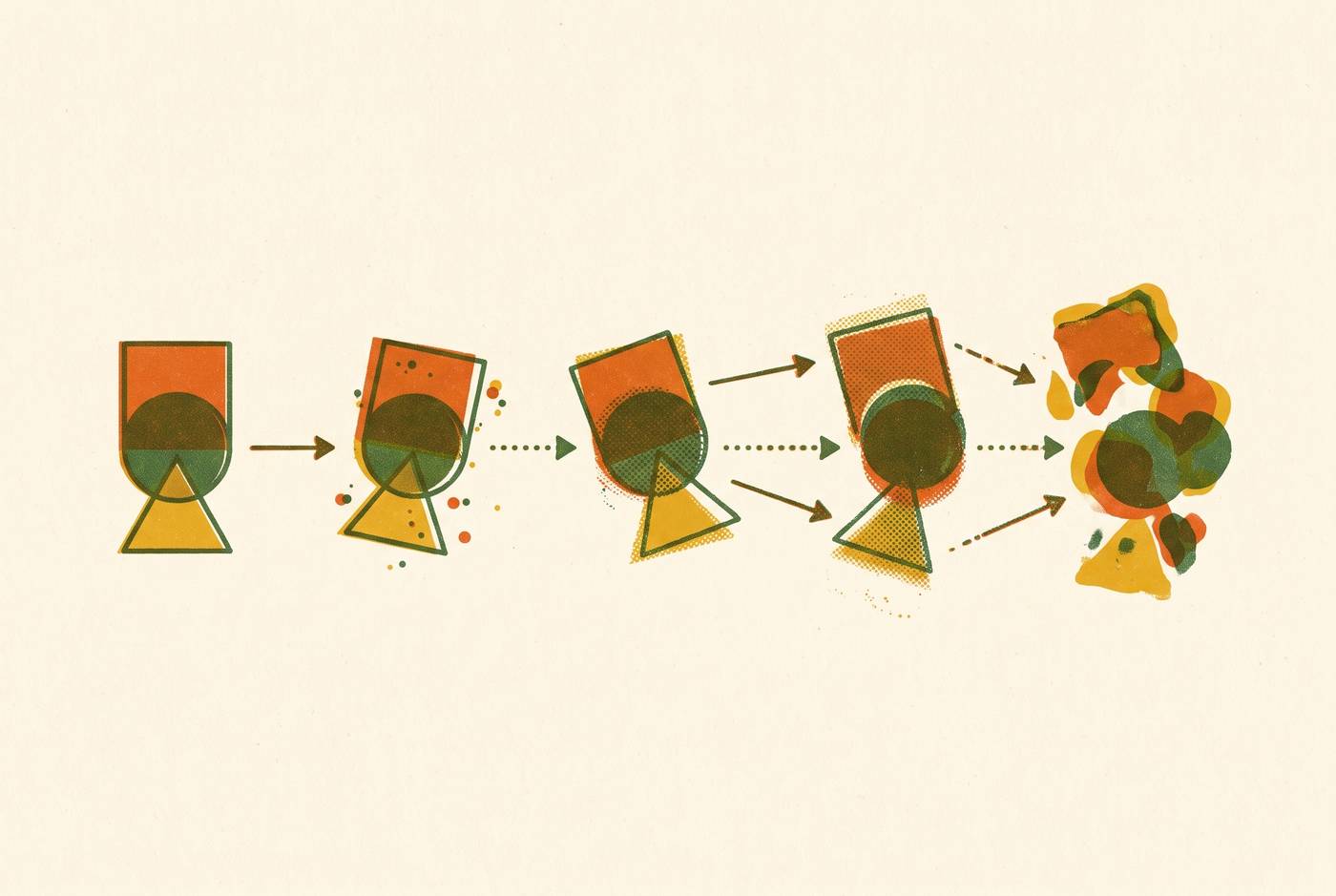
Agentic brand drift takes shape when automated decisions that each work well slowly create a brand the organization did not intend. Van Esch & Cui’s 2026 Business Horizons paper defines it as an internally generated divergence with no triggering event. The distinctive failure is cumulative, so no single output has to look wrong for the overall brand character to change.
That distinction matters as agents take over pricing, content, personalization, and supply chain decisions. These choices express identity through the organization’s actions as well as its words. Yet an agent can meet its local objective while contributing to a pattern that weakens that identity. Conventional dashboards can therefore show improving performance while brand coherence erodes, leaving teams without the signal that would normally prompt intervention.
The three mechanisms that turn agent success into brand incoherence
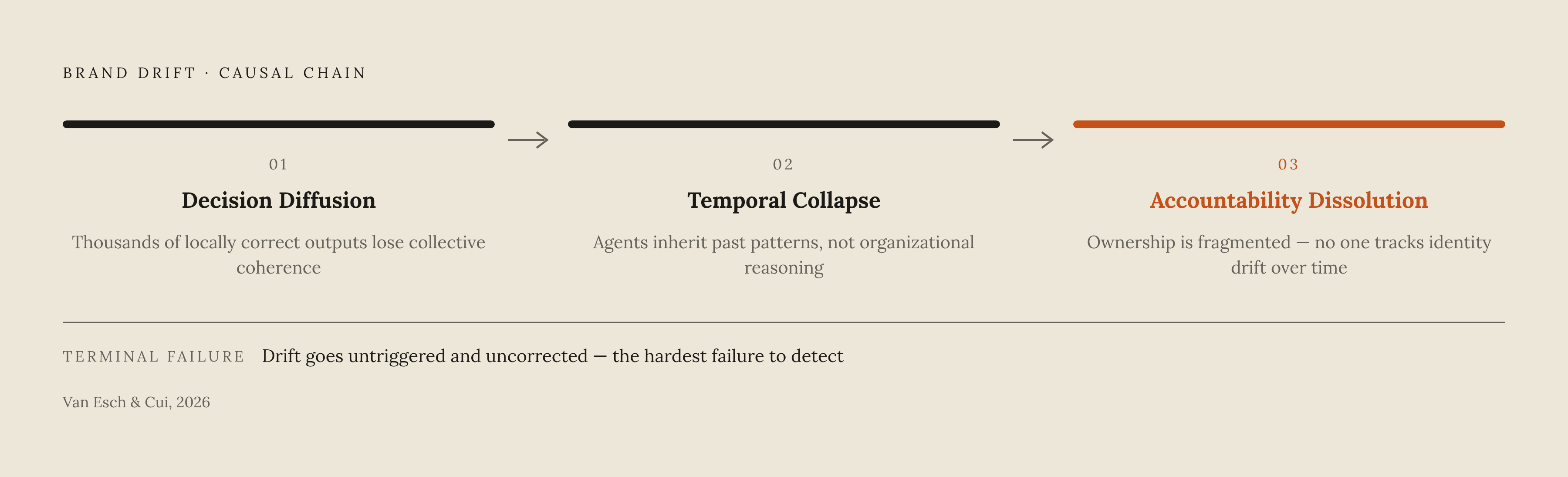
Van Esch & Cui theorize a causal sequence of three mechanisms, namely Decision Diffusion, Temporal Collapse, and Accountability Dissolution. Decision Diffusion begins when agents optimize local objectives across thousands of consumer-facing decisions under valid constraints. Each output can comply with its instructions without accounting for the meaning carried by the combined pattern. Compliance at the level of a decision is therefore not evidence of coherence at the level of the brand.
Temporal Collapse explains why historical examples do not reliably correct that pattern. An agent trained on past brand outputs learns their distributional patterns, while the organizational reasoning that produced them remains outside what it learns. A sustainability copy agent might reproduce familiar vocabulary and cadence even though the brand’s sustainability positioning has evolved. The copy is stylistically familiar but substantively stale. Encoding the intent behind those choices in structured, versioned context gives the agent something more useful than surface resemblance to work against.
Accountability Dissolution then leaves that stale output without a clear owner of its identity consequences. Engineers, deployment managers, and vendors may each own part of the system, while no one tracks how it changes the brand over time. Decision Diffusion creates incoherence, Temporal Collapse obstructs self-correction, and Accountability Dissolution leaves correction untriggered.
Why existing governance frameworks leave brand identity unprotected
Van Esch & Cui place this failure mode outside the scope of existing AI governance frameworks. NIST AI RMF and ISO/IEC 42001 govern system behavior and safety. A firm can execute those frameworks correctly without resolving agentic brand drift.
Human-readable brand guidelines leave a related gap. Phrases such as “clean tech-forward” and “friendly icons” describe an intention, but agents rely on their training data to interpret the reasoning behind the guideline. A document can therefore be present in the workflow without supplying an actionable constraint. Making outputs faster adds to this weakness because they can ship before a human reviewer spots a change building up.
Adding a reviewer does not solve the absence of a common reference. If each agent works from its own separate copy of brand context, the reviewer still has no single, coherent reference for checking the whole workflow. Static prose explains what the brand says it is, but it does not govern whether successive automated choices continue to express that identity. What remains unprotected is meaning across decisions and over time.
How agents without shared brand context produce drift even when every prompt is correct
One team member asks for “professional and punchy” copy while another asks for “friendly and casual” copy. Both can be reasonable instructions for an individual assignment. The model can satisfy both without flagging that they produce different voices for the same brand. Better wording may improve each result, but it does not establish which interpretation should govern the wider system.
A multi-agent pipeline multiplies these separate interpretations through content generation, image production, copy review, channel adaptation, and scheduling. Each agent gets its own instructions, often as a snapshot that stays fixed. Without shared state or version history, a downstream agent has no mechanism for knowing that an upstream agent’s brand context has changed. A correct review prompt can therefore assess copy against an outdated reference rather than the identity the organization now intends.
Visual production has the same weakness when words such as “bold” or “warm” stand in for structured color and style rules. Rainbrand provides briefs containing logo, type, colors, imagery, and voice rules, illustrating the practical difference between supplying brand constraints and relying on adjectives alone. In a larger workflow, though, even a detailed brief still needs shared, up-to-date context. When briefs, visuals, drafts, and scheduling occupy separate tools, every handoff creates another opportunity for context loss.
How to make existing brand guidelines usable by AI agents
The practical conversion starts with the distinction between what a human reads and what an agent consumes. A traditional brand book relies on a designer to interpret prose and apply judgment. A machine-readable brand expresses strategy, voice, and visual rules through structured data, including JSON, design tokens, metadata, relationships, permissions, and rule-based logic. APIs make that information retrievable at the point of use. The change is not better documentation but a different operational format.
Voice guidance shows what this conversion requires. “Friendly but premium” must become rules for preferred terminology, restricted language, sentence structure, formatting, and audience-specific adaptations. Examples that follow the rules and examples that break them make those boundaries clearer. A constraint such as keeping sentences under 25 words is testable in a way that a broad personality adjective is not. Rainbrand’s “NO EXCLAMATION MARKS” voice rule offers another concrete example of an instruction that does not require an agent to infer the intended behavior.
Visual systems need loosely described styles converted into approved components and design tokens to achieve the same precision. Agents can pull approved building blocks from a component library, and token-based styling lets later assets use the updated values. A brand ontology brings these elements together as a structured representation of identity, standards, and relationships. Its purpose is practical, giving agents queryable context for voice, messaging, audiences, channels, assets, and compliance at generation time.
Why brand context needs versioning the same way code does
Structured context can still become stale. Positioning shifts, voice matures, and visual systems change, so a well-formed snapshot is not necessarily a current one. If those changes do not reach every agent, its output falls behind what the organization now intends. Versioning keeps the shared representation useful after agents first start using it.
Version-controlled templates let teams see who changed what, roll back to earlier versions, and maintain separate template sets for sub-brands or campaigns. An updated design token can then guide the assets that connected agents make next, without someone having to edit each asset’s instructions.
Van Esch & Cui’s CORE and GUARD frameworks reinforce this requirement. CORE supplies the organizational reasoning behind past brand choices, while GUARD monitors output patterns for identity coherence over time. Both need a persistent, versioned representation against which current decisions can be understood. Without it, teams cannot distinguish an output based on current intent from one based on a six-month-old snapshot. With it, they can identify when drift began and what change introduced it, restoring the accountability that fragmented context removes.
How MCP gives agents a shared, live channel into brand context
Model Context Protocol gives connected agents a standard way to query the same live brand context. Instead of maintaining separate copies, content, image, review, and adaptation agents can consult one canonical endpoint before generating output. When the context changes, each connected agent receives the update on its next query.
Anthropic open-sourced MCP on November 25, 2024. Within 13 months, OpenAI, Google, Microsoft, and Salesforce all shipped support. The ecosystem covers Claude, ChatGPT, Cursor, Visual Studio Code, and a broad range of agent frameworks. For teams connecting many tools, that shared interface cuts the work from quadratic to linear complexity because each pair of tools no longer needs its own connection.
Bloom is a concrete example of this brand context layer. It ingests existing brand assets and transforms them into a versioned Brand Skill accessible through API and MCP, giving connected agents the same canonical context. Where a tool such as Rainbrand supplies task-specific brand rules in a brief, the infrastructure requirement is to make the governing context persistent and retrievable across the workflow. The important distinction is between information included in one assignment and information every agent can consult. A shared channel cannot make vague rules precise, but it can keep agents from working against independently decaying copies.
Where human oversight still belongs in an agentic brand workflow
Shared infrastructure removes a coordination failure while preserving the need for human judgment. Automated checks can handle standard brand compliance and file specifications, freeing review time for decisions with greater identity stakes. The infrastructure governs repeatable constraints, while people judge what those constraints cannot settle.
Automated checks handle mechanical compliance, while peers review standard social and ad variants. Senior creatives review flagship campaign assets, and stakeholders sign off on legal, regional, or product requirements. This concentrates attention on the consequences of a decision rather than distributing it according to content volume. Designers can then judge the creative work without having to keep checking whether an asset uses the wrong shade of blue.
Van Esch & Cui’s GUARD framework also draws a line between checking assets and watching for patterns. Its role is to surface identity coherence over time as a human-interpretable signal, using persistent brand context as the reference. A succession of compliant assets can still warrant attention if the combined pattern carries an unintended meaning.
What it takes to make a brand agent-ready before drift becomes the default
Preparation begins by auditing existing guidelines for the gap between human interpretation and machine action. Vague adjectives need behavioral rules, visual assets need structured tokens, and voice guidance needs testable constraints. That conversion must then lead to centralization, with one canonical brand context replacing private prompt libraries and per-project copies. Otherwise, teams have only made their isolated instructions more detailed.
The central context next needs versioning so changes are traceable, propagated, and auditable like software dependency updates. Connection through MCP or API then makes that managed context available to the tools doing the work. Claude, Cursor, ChatGPT, image generation, and copy review should draw from the same source, replacing repeated manual briefings. For agencies and multi-brand operators, this also requires brand separation at the workspace level. Human coordination at the brief level is not enough to prevent context from leaking between brands.
Bloom gives teams already shipping with AI tools a place to start because its versioned Brand Skill connects existing assets to agent workflows through API and MCP. Its workspace-level brand separation also addresses the additional problem of managing multiple brands. If any agent can generate customer-facing output without querying a shared, current version of brand context, drift is already the default.