Brand Tokens as a Canonical Design Language for AI Pipelines
Structured brand tokens let AI agents pull from canonical identity data instead of guessing.
Brand tokens are the structural fix for a specific failure: AI agents now generate colors, copy, and code at machine speed, but most brand guidelines still live as prose a human has to interpret. A versioned brand identity system for AI teams replaces that prose with named, typed, machine-readable values, so every connected agent, from a design tool to a coding assistant, pulls from the same canonical source. That shift, from documentation to data, is what this piece lays out.
AI Agents and Brand Consistency
Brand decisions used to flow through a small number of trained people: a creative director, a handful of designers, maybe one copywriter who had internalized the tone guide. Now that every team member can generate copy in one tool, images in another, and front-end code in a third, those decisions no longer pass through a checkpoint. They leak out of dozens of independent prompts, each one making its own small judgment call about what the brand looks and sounds like.
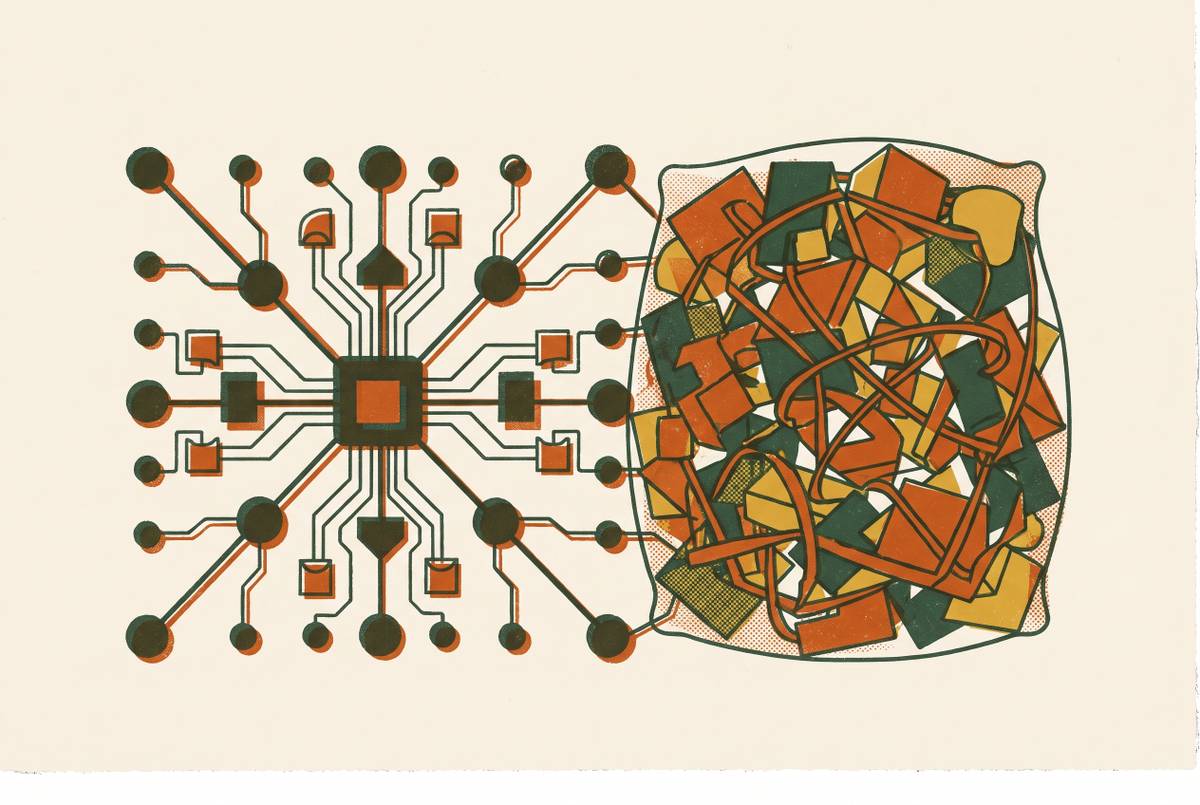
AI models are not bad at design or writing. Without structured brand context, a model falls back on the statistical average of what it has seen, and the result is plausible but generic: on-trend, technically competent, and indistinguishable from what a hundred other products would generate under the same prompt. That is the core structural mismatch. Guidelines exist as prose for humans to interpret, but agents need something they can query and act on directly.
The cost of this mismatch compounds because users register inconsistency even when they cannot name it. Trust in a brand is built cumulatively, and structured token context is what keeps that cumulative signal from degrading as more of the output gets produced by machines rather than people.
What design tokens are and why their data model is different from a style guide
A design token is a named, structured variable that stores a brand decision as data. A style guide says "our primary color is a confident indigo." A token says color.primary = #6366F1, typed, versioned, and addressable by any system that can read JSON. Structured data is machine-consumable, and that is what distinguishes a brand decision expressed as a token from one expressed as descriptive language.
The same logic extends well past color. Typography scales, spacing rhythms, border radii, motion curves, and voice parameters like tone formality or sentence-length constraints can all be expressed the same way: as named values with a defined type, sitting in a file a pipeline or an agent can read directly. The structural property that makes this work is decoupling. The intent behind a decision (why this color represents the brand) is separated from its implementation (what exact value, in what format, on what platform). A single decision can then propagate across web, iOS, Android, and email without anyone manually translating it for each context.
Consider what happens without that separation. A single tokens.json file collapses that into one change that propagates everywhere it is referenced. This works at scale because of a shared syntax. The W3C Design Tokens Community Group's DTCG standard reached its first stable version, 2025.10, in October 2025, and it established $value and $type as the de facto properties for expressing a token. Because of that standardization, tools from different vendors can read the same token file without a custom translation layer in between.
The three-tier hierarchy that gives tokens semantic meaning an AI agent can act on
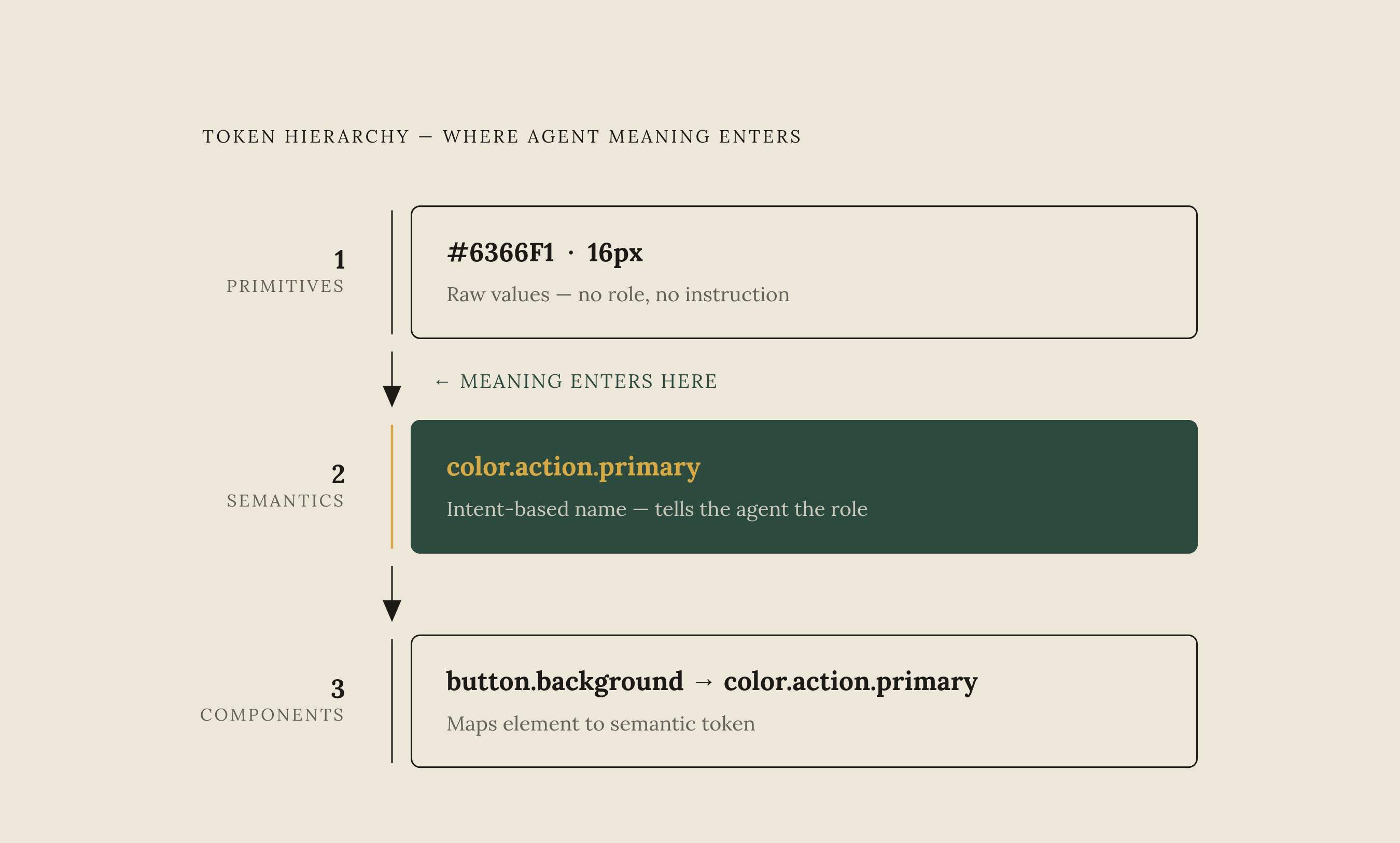
Raw values alone do not give an AI agent enough information, so it cannot make a correct brand decision. A hex code tells an agent what a color looks like, not what role it plays. The semantic layer, sitting between the raw value and the finished component, is what turns a color into an instruction an agent can act on with confidence.
The structure generally has three tiers. Primitives hold raw values, such as a hex code or a pixel measurement. Semantics attach intent-based names to those primitives, such as color.action.primary. Components map those semantic tokens onto specific elements, such as a button's background color referencing the semantic primary-action token. The naming at the middle tier is what matters most for an AI pipeline: color.action.primary tells an agent that this value governs primary interactive elements, while #6366F1 on its own carries no such information. An agent needs that intent context to make brand-consistent decisions on its own, rather than needing a human to specify, case by case, which element should use which value.
This structure also makes a brand resilient to its own evolution. When a rebrand changes the primary color, only the primitive value needs to change. The same architecture supports multi-brand organizations: a core set of primitive tokens can be selectively overridden for sub-brands or regional product lines, giving individual teams autonomy without fragmenting the global identity into incompatible copies. Engineers will recognize the underlying logic. It is the same reason software uses constants and interfaces instead of hard-coded values scattered through a codebase: the system becomes correct by construction rather than correct by discipline, and discipline is exactly the thing that breaks down once dozens of people and agents are generating output in parallel.
The CI/CD Pipeline for Tokens
A token file sitting on a shared drive still requires a human to export it, distribute it, and paste it into whatever tool needs it next, which reproduces the exact ad-hoc behavior tokens are supposed to replace. So the fix is to treat token updates the way software treats code commits, not as static documents someone occasionally refreshes.
In a working pipeline, a designer changes a color token in the design tool, and a continuous delivery process automatically opens a pull request in the code repository, updates component documentation, and notifies downstream teams. No one manually exports a file or pastes new values into a different system. That automation creates a natural point for a quality gate: automated visual regression checks can verify that no component has drifted from its token values before a change reaches production. Automated design validation of this kind has been shown to cut design inconsistencies by 92%, and it catches the half-shade color drift or the missing spacing value that would otherwise compound silently across dozens of components and go unnoticed until a user complained.
Once this pipeline is live, the payoff for AI pipelines is that an agent generating a new UI component is always working against the current, canonical brand state. The overhead is real but front-loaded: once the pipeline runs, it removes the continuous manual labor of keeping Tailwind configs, native app themes, and documentation synchronized by hand, which is the labor that was producing the drift in the first place.
What MCP Adds for Brand Token Context
A pipeline keeps tokens current, but an agent still needs a way to ask for them at the moment it is generating something. That is the role of the Model Context Protocol, an open standard now hosted by the Linux Foundation's Agentic AI Foundation, co-founded by Anthropic, Block, and OpenAI, with Google and Microsoft as platinum members. MCP is becoming the interface through which agents pull in context before they create anything, which makes it a natural protocol layer for exposing brand tokens directly to the tools that need them.
Figma's Dev Mode MCP server, released June 4, 2025, is the clearest published case of this working in practice. The kind of task this enables is specific: a request such as "update all primary call-to-action buttons across brands to a 16px corner radius" can be handled by a model that reads tokens and component metadata through MCP, applies the update across every brand it has access to, and runs regression checks to flag anything that looks wrong.
This capability comes with a trade-off that deserves direct attention. Exposing a full brand context naively through MCP can be expensive in model tokens. The lesson for brand teams wiring multiple MCP servers is to scope context tightly: surface the specific tokens and rules relevant to the task an agent is performing right now, not the entire brand archive on every call. That scoping decision belongs in the architecture from the start, not as a fix applied after costs or latency become a problem.
Voice and content tokens: extending the machine-readable brand beyond visual identity
Without a voice equivalent to a color token, that entire surface area has no canonical, machine-readable source to draw from, and it is the surface area where brand inconsistency is often most visible to a reader.
The gap between documentation and data is visible here. A brand guideline might say "our tone is warm and direct." A machine-readable voice token encodes that same intent as structured, addressable values: formality scored on a defined scale, a list of banned words, a constraint on sentence length, a declared pattern for CTAs. Each of those is a value an agent can read and apply, rather than a phrase it has to interpret on its own judgment. A practical bridge already exists for teams working with AI coding assistants: a CLAUDE.md file or equivalent context file at the root of a project gets read automatically by many agents, making it possible to reference token files and voice rules without re-pasting guidelines into every new session.
The underlying pattern matches the one from visual tokens exactly. Tribal knowledge, the kind of internal understanding that lives in a creative director's head and gets described as "we sound like this," gets replaced with explicit, versioned rules: formality set at 0.3, a defined list of banned terms, a CTA pattern specified as verb-first imperative. Without that structure, two different agents working from the same prose guideline, one drafting a product email and another generating social copy, will independently interpret "warm and direct" and land on genuinely different tones, even though both were given identical instructions. The token architecture closes that gap because it makes the interpretation step unnecessary, so two separate systems no longer have to interpret the same sentence the same way.
Bloom as the Brand Infrastructure Layer
Everything above points to the same conclusion: teams need one canonical, versioned, retrievable source of brand context that every connected agent and workflow can query, not a collection of files someone has to manually paste into each new session. That is an infrastructure requirement, not a design-tool feature, and it is the specific gap that brand infrastructure platforms are built to close.
Bloom ingests a brand's existing assets, including guidelines, files, websites, social profiles, and design systems, and structures them into what it calls a Brand Skill: a versioned, retrievable representation of aesthetics, voice, references, and assets that agents can pull via API or MCP. That structure is a direct instance of the token architecture described throughout this piece: one canonical source of truth, versioned the way code is versioned, consumed by any connected tool, whether that is Claude, Cursor, ChatGPT, or another MCP-compatible environment, without each team member manually re-establishing context before they start work.
The multi-brand case maps onto the same core-plus-override logic described earlier for enterprise sub-brands: an agency managing several clients, or a company managing several product lines, needs a shared global architecture with room for individual brands to diverge where they genuinely need to. And the pipeline property that matters most for consistency, automatic propagation, holds at this layer too. When a brand's token set or voice rules get updated within Bloom, every downstream system that queries it inherits the change automatically, extending the automatic-propagation guarantee of a CI/CD pipeline to the level of brand infrastructure as a whole.
What "agent-ready" requires when you audit your current brand setup
Most teams are not starting from zero. They have design files, a brand guideline document, and some amount of existing AI tool usage scattered across the organization. The gap between that starting point and a genuinely agent-ready brand is specific enough to diagnose directly, rather than something vague that only gets fixed by buying a new tool.
The audit itself starts by identifying every place where a brand value, whether color, spacing, type, voice, or CTA rules, currently exists as prose, a screenshot, or a hard-coded value rather than as a named, addressable token. From there, the honest questions are structural. Visual tokens should be organized into primitive, semantic, and component tiers, so they do not exist as a flat list of hex codes with no naming convention behind them. A delivery pipeline should propagate token changes automatically, so no one has to remember to export and redistribute a file. Voice and content rules should be expressed as structured parameters, not as prose an agent has to interpret fresh every time. A single, versioned source of brand context should exist for agents to query at the moment they generate something, rather than each workflow carrying its own outdated copy. And MCP-compatible endpoints, or equivalent API access, should be in place so agents can retrieve current brand context directly instead of relying on whatever was pasted into a prompt weeks earlier.
The sequencing matters as much as the checklist itself. Automation should come after the underlying tokens are clean. A CI/CD pipeline or MCP integration built on top of inconsistent, un-tokenized brand assets does not fix the inconsistency: it propagates that inconsistency faster and at greater scale than any manual process could have managed on its own. Brand tokens deserve the same governance a software dependency gets: versioned, reviewed before changes ship, and consumed by downstream systems through a defined interface. The teams that treat brand identity this way are the ones whose AI-generated output, across every agent and every tool, still looks and sounds like one brand a year from now.