Versioning Brand Guidelines the Way Engineers Version Code
Machine-readable brand tokens let AI agents apply guidelines consistently at scale.
Brand guidelines fail at AI scale for a structural reason, not a compliance reason: they were built for a human to read once, and an AI agent needs to pull context at runtime, on every single generation. That mismatch, not weak enforcement or indifferent teams, is why brand systems break down the moment agents enter the workflow.
Why brand guidelines break down when AI agents enter the workflow
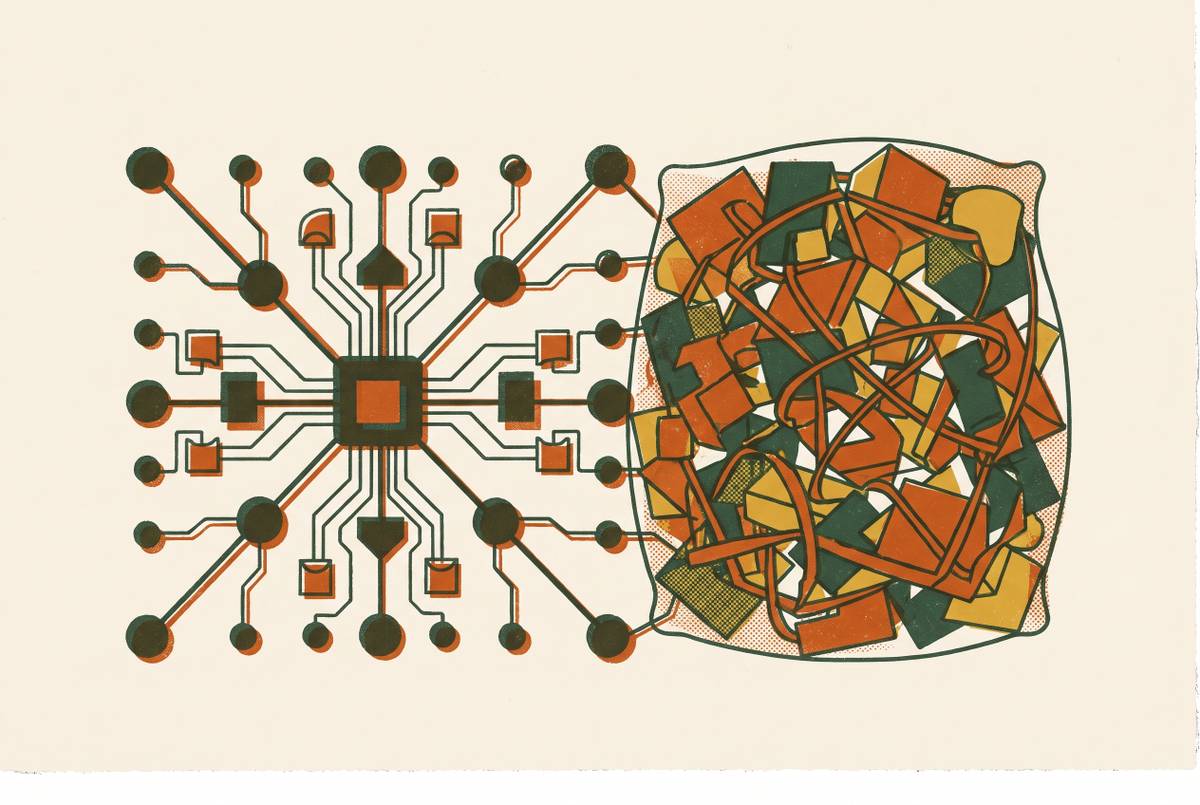
A brand document written for a person assumes a reader who absorbs tone and color and spacing once, retains an impression, and applies judgment to the next hundred decisions without consulting the page again. An AI agent has no such memory and no such judgment. It generates from whatever context sits in its window at the moment of the request, and when that context doesn't include machine-parseable brand rules, the model falls back on probabilistic web averages: a font that's close enough, a blue that isn't quite the brand's blue, copy that reads like every other company's copy. None of this happens because the model ignored the guidelines. It happens because the guidelines exist as prose, and prose is not a format a model can reliably convert into an executable rule.
The damage scales with volume. A single AI-generated post built without canonical context is a minor inconsistency. A hundred AI-generated assets across a dozen channels, each one generated independently without a shared source of truth, is a hundred independent chances for drift, and that drift accumulates. Nothing in the system averages errors back toward center. Each generation starts over, and each one can miss in a new direction.
The PDF or long-form brand book was always a shaky foundation, and AI exposure just made the cracks visible. These documents were already hard for human teams to use well: too long to read in full, difficult to search, and frequently outdated by the time someone opens them again. None of that changes for the better when a machine is the reader. A PDF has no path to machine readability at all, no matter how well-designed its pages are.
Static documents decay from the day they're published, because they record decisions without the reasoning behind them. A guideline might say "use this blue," but it rarely says why that blue exists, what it's for, or how to adapt it when a new, unanticipated situation arises. A human designer can often guess at the reasoning and extend it sensibly. An agent cannot, and agents encounter unanticipated cases constantly, every time a channel, format, or use case falls slightly outside what the original document anticipated.
How software engineering solved this with version control
Software engineering faced an almost identical problem decades ago: how does a team keep a shared body of logic consistent, current, and reliable when many people and machines need to read and modify it constantly? Version control was the answer: the precise architecture brand systems now need, with tooling to run it that already exists.
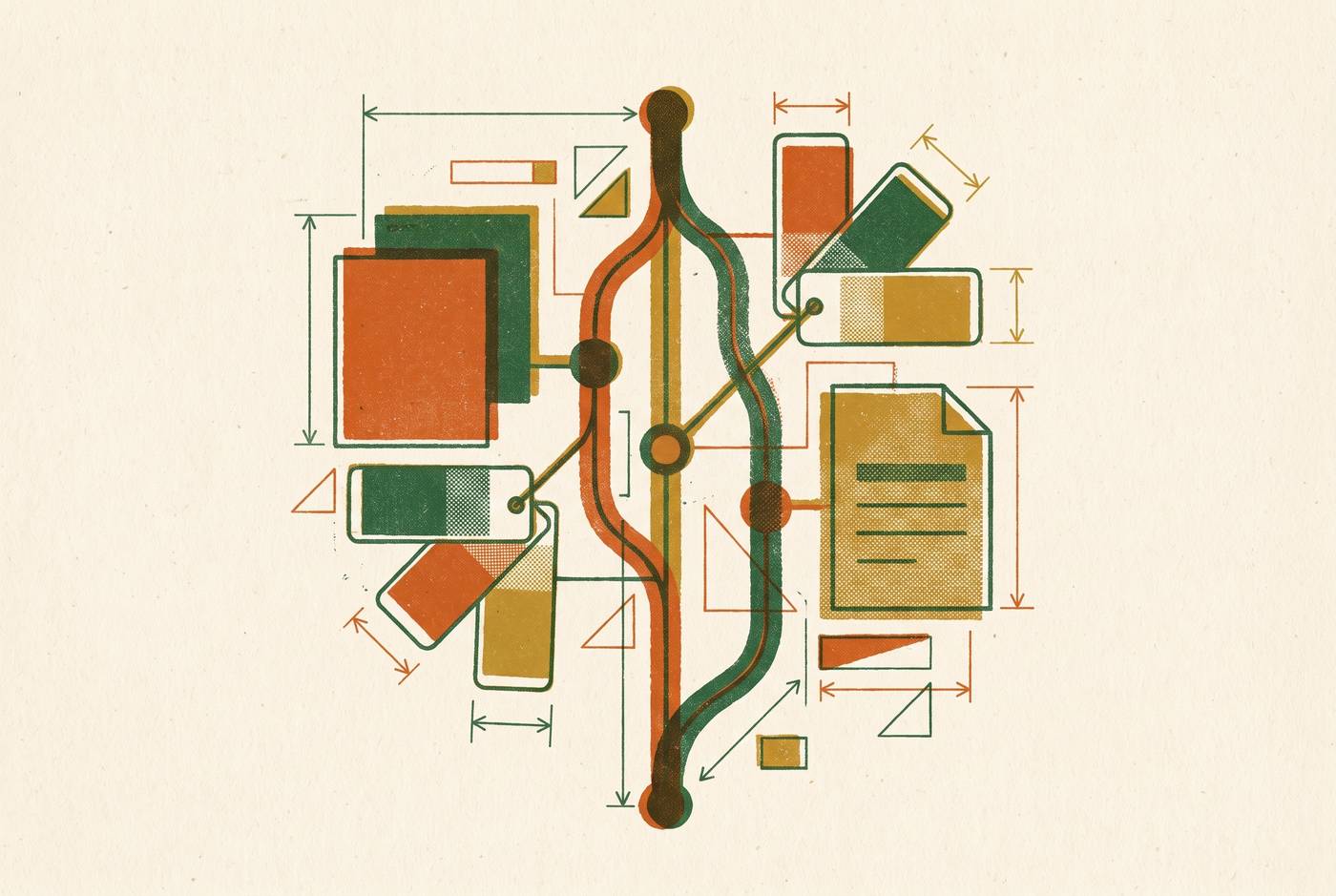
Version control works because every change is tracked as a discrete, reviewable unit. When an engineer changes a single value in a configuration file, the system records what changed, who changed it, and when. If a designer changes a brand's primary color in a token-based system, the resulting diff is one line: the old value, the new value, nothing else touched. You can review that single line before it ships, so a brand change goes through the same scrutiny as a code change, instead of slipping into a redesigned slide deck that nobody signs off on.
Version control also solves the problem of duplication. The moment a second file holds the same values by hand, independent of the first, the two will drift apart, because someone updates one and forgets the other. A single canonical source is the architectural precondition for consistency at any scale beyond one file and one person.
What makes this convergence notable is that it happened independently in two different disciplines. Engineers built version control to manage source code. Design systems teams worked from entirely different constraints, but they arrived at structured, single-source token systems to manage visual and verbal identity. Two fields solving different problems landed on the same underlying pattern, and that convergence is evidence the pattern is correct.
Structured brand tokens and semantic naming for agents
Turning a brand guideline into a version-controllable system starts with converting its decisions into tokens: structured, machine-readable values stored in a format any tool can parse, typically JSON or YAML. The format alone isn't what makes tokens useful to an agent. Whether an agent can apply a token correctly or only copy it superficially comes down to the naming convention.
Tokens are organized in three tiers. Global tokens hold raw values: a specific hex code, a pixel measurement. Alias or semantic tokens describe what that value means in context, translating a raw number into a purpose. Component tokens then apply those semantic values to specific interface elements, so a button's border color inherits from a semantic token rather than from a raw hex value repeated in a dozen places.
Semantic naming carries real weight here because it gives an agent the intent behind a value, not just the value. A token named color.surface.elevated tells an agent what that surface is for. An agent reasoning about a card background with that semantic label produces a more defensible, context-aware choice than one working from a bare hex code with no label attached to its purpose.
Voice and tone need the same treatment visual tokens get. A guideline that says a brand should sound "friendly but premium" gives an agent two adjectives and nothing to execute against. Turning that into something usable means specifying preferred terminology, restricted language, sentence structure, formatting conventions, how tone shifts across audiences, and paired positive and negative examples showing what compliant and non-compliant copy actually look like. Adjectives describe an impression. Rules are what a model can follow.
This isn't a theoretical exercise. The W3C Design Tokens Community Group reached a 1.0 specification in October 2025, after four years of incubation, defining a JSON schema covering color, dimension, fontFamily, fontWeight, shadow, typography, and other composite types, with strict type rules and a referencing system for aliases. Style Dictionary, Tokens Studio, and Figma's variables panel already implement it, so a token-based brand system is a supported standard, not a format a team has to invent from scratch.
In April 2026, Google Labs open-sourced DESIGN.md, a format spec that tells coding agents how to read a visual identity. It pairs YAML frontmatter, carrying the machine-readable tokens, with a Markdown body carrying human-readable rationale, and it ships with a linter that validates structure, flags broken token references, and runs WCAG AA contrast checks. That linter adds a governance layer on top of the token standard itself, catching errors before they reach production.
Most practitioners converging on this approach use JSON as the compilation source feeding tooling pipelines that output CSS variables, iOS resources, and Android resources, while DESIGN.md serves as the agent-facing interface, carrying both the tokens and the reasoning an agent needs to apply them correctly.
Versioning brand context the way code is versioned: changesets, ownership, and the change log
Version discipline, not tokens alone, solves decay. A structured token file with no version discipline will drift and fork exactly the way the PDF did, just in a more sophisticated format. The fix is to treat brand changes the way engineering teams treat code changes: intentional, reviewed, and logged.
A few practices carry over directly from engineering, and none of them require a platform build. Give each content type a single canonical owner, the same way a module has a code owner, so one person is accountable for every token and rule. A public change log, recording schema updates and canonical rule changes as they happen, lets every downstream consumer, human or agent, know what changed and when. A review cadence replaces the annual refresh: quarterly checks on high-traffic rules, monthly checks on pricing and offer-adjacent content, and legal sign-off on sensitive answer templates. And changes to the canonical source should propagate automatically to every downstream system, removing the manual copy step that is where brand drift actually originates today.
The underlying principle is that brand identity functions as a living system, updated the way code is updated: in tracked increments, with every downstream consumer inheriting the latest version automatically. Without that discipline, an agent trained or prompted on last quarter's brand keeps generating last quarter's brand: retired product names, deprecated colors, a voice the company moved away from months earlier. Nothing in an unversioned system tells the agent anything changed, so it has no reason to stop.
Stale documentation does more than sit unused. It actively trains the people and agents consuming it to distrust the whole system, because once one rule is visibly wrong, there's no way to know which others are. A versioned system makes staleness visible and fixable the moment it appears, rather than letting it accumulate quietly until someone notices the brand has drifted in six different directions at once.
Delivering versioned brand context to agents at runtime with MCP
Structured, versioned tokens solve half the problem. Getting that context into an agent's hands at the exact moment it generates something is a delivery problem, not a data problem. The Model Context Protocol, known as MCP, is the mechanism that makes this automatic.
MCP is an open protocol that lets an AI application, such as Claude, ChatGPT, or Cursor, connect to external tools and data sources with one integration per client and one per tool, rather than a separate integration for every client-tool combination. The current specification is dated July 28, 2026. Anthropic introduced MCP in late 2024 and donated it to the Linux Foundation's Agentic AI Foundation in 2025, co-founded alongside OpenAI and Block, with Google, Microsoft, AWS, Cloudflare, and Bloomberg backing the effort. That breadth of participation is why MCP functions today as the de facto standard for how agents talk to tools.
For brand systems specifically, MCP replaces copy-paste. Brand tokens, tone rules, and guardrails get injected directly into an agent's context window during execution of every prompt, automatically, without a person manually supplying them and without the risk of someone forgetting a step or pasting an outdated excerpt.
The Webflow MCP server shows what this looks like in production. Its built-in guardrails keep an agent working within a site's existing roles and permissions, every change the agent makes appears in the site's activity log, and each site can define Agent Instructions, markdown-based rules covering the site's design system, voice and tone, CMS conventions, and other requirements, stored on the site itself and followed by any connected agent. That's a working example of versioned brand rules enforced at the tool layer, not just described in a document somewhere upstream.
Block offers a second data point at enterprise scale. The company built more than 100 internal MCP servers and runs Goose, an open-source AI agent built on MCP, across use cases that include compliance workflows. That matters because it shows MCP-based context injection can hold up even when governance requirements are far stricter than most creative use cases demand, not just work for low-stakes content generation.
Put together, these pieces map onto what practitioners call AI brand governance: machine-readable tokens as the structured data, context injection through MCP as the delivery mechanism, and automated validation scanning outputs in real time for non-compliance before anything publishes. Each piece depends on the one before it. Tokens without delivery are inert. Delivery without validation has no check on whether the agent actually followed the rules it received.
What a brand infrastructure layer does beyond a prompt or style guide
Generic AI tools start from zero every session. They carry no memory of what a brand decided last week, no access to its token system, and no way to learn that a rule changed. A prompt pasted at the start of a conversation is a one-time, manually supplied patch over that gap, and it's forgotten the moment the session ends.
A brand infrastructure layer closes that gap differently: a versioned, retrievable representation of a brand's aesthetics, voice, references, and assets that any connected agent or product can pull from through an API or through MCP. The difference from a prompt is structural. A prompt is session-scoped, manually supplied, and never updated when the brand changes. Infrastructure stays persistent, it injects automatically, it's version-controlled, and it propagates updates to every downstream consumer at once.
Superside's Brand Brain illustrates what this looks like when it's running. It sits at the center of Superside's operating model as a living AI intelligence layer, capturing each customer's brand guidelines, tone, messaging, prior assets, feedback, performance signals, and creative decisions. It supports structured briefing, on-brand asset generation, and agents that draw on accumulated creative knowledge for new projects, while a human-in-the-loop process keeps strategic direction, craft, taste, and final review with senior talent. The content engine gets more capable as its library grows, rather than restarting from nothing with every new session.
Bloom occupies this same layer. It ingests a brand's existing assets, guidelines, files, websites, social profiles, and design systems, and converts them into a Brand Skill: a versioned, retrievable brand context that any agent connected through API or MCP can pull from at runtime. Every generation then starts from the full canonical brand, not from a blank session and not from a manually pasted excerpt that may already be out of date.
This architecture gets more valuable, not less, when a workspace manages multiple brands at once. Shared infrastructure with isolated context per brand is what separates governance from chaos at scale, for the same reason engineering teams run one version control system across many projects. Brand context works best as a pooled, shared resource, for the same reason a codebase is shared infrastructure rather than copied individually for every developer who touches it.
Converting existing brand guidelines into a versioned, machine-readable system
None of this requires discarding the brand work a team has already done. You need to re-express existing decisions in a format a machine can read, so start from what's already documented and build toward the token structure and delivery layer described above.
Start by auditing the existing guidelines for the decisions buried inside them: colors, typography, spacing, voice rules. Sort each one into prose that isn't yet actionable for an agent versus specific values that are already close to ready for tokenization. From there, write a DESIGN.md file. Begin with tokens, colors with names and hex values, typography, a spacing scale, and breakpoints, using YAML frontmatter so an agent can parse it directly. Add core component variants next, primary and secondary buttons, card styles, form inputs, as structured definitions. Then add the rationale for each decision in the Markdown body, so an agent has the reasoning behind a rule, not just the value.
Name every token semantically from the outset: color.surface.elevated, not a raw hex or color-scale reference. A semantic name carries intent; a raw value carries none. Establish a change log and assign a single owner per content type before the first token ever ships, so the governance structure already exists the moment the first update needs to go out. Finally, connect the token source to a delivery mechanism, an MCP server, an API endpoint, or a brand infrastructure layer like Bloom, so agents pull canonical context at runtime instead of relying on whatever someone remembered to paste into a prompt.
None of this demands a full design system build on day one. A plain text file with tokenized colors, typography, and core voice rules, committed to a repository with a change log, already performs better for agent consumption than any polished PDF ever could.
Brand guidelines have always existed to give a company a single source of truth for its visual and verbal identity. Versioned brand infrastructure is the version of that goal built for a workflow where machines read it constantly: an update made once propagates automatically to every connected agent, every time.